How to Actually Unplug: A Realistic Guide for People Who Struggle Slowing Down
You've wanted a real break for months. Here's why it keeps not happening — and how to fix it before summer fills up.
Let's be honest about what happens when you try to take a vacation break...
You book the time off (woohoo!). You make a list of "relaxing things to do." You download a meditation app you won't use and pack three books. And then you spend the first day half-present, checking email or social with one eye, mentally drafting the catch-up you'll need to do when you get back.
By day two, you're a little better. By day three, you're almost there. And then… it's time to go home.
Sound familiar? You're not alone — and you're not broken. You're just a person who's spent years practicing the skill of being busy, and now your brain is (very) good at it. Unplugging is actually a skill. And like most skills, it takes practice, intention, and the right environment.
This is a guide for doing it for real.
First: Admit That "I'll Rest When I Get There" Is a Little Lie
The biggest myth about vacation is that rest will happen automatically once you arrive somewhere different. It won't — at least not on its own. If you've been running at full capacity for months (years?), your nervous system doesn't know how to just stop. It needs permission. It needs structure. It needs a little friction removed.
This is why the environment matters so much. When your phone still gets signal, you'll check it. When you have a hundred options for how to spend your day, you'll optimize instead of relax. When there's ambient noise and other people and a packed itinerary, you'll never quite exhale.
Choosing the right place is the first step. Not a resort with an overwhelming spa menu and poolside cocktail service — that's stimulation in a different costume. Something quieter; smaller. A cabin in the woods where the main activity is sitting still and noticing things.
Rest doesn't happen automatically. It requires the right conditions — and the willingness to let them work.
The 24-Hour Rule
Give yourself full permission to be “useless” for the first 24 hours. Not semi-useless. Not "I'll just check in once and then put my phone away." Actually. Useless.
This sounds indulgent. It is indulgent. That's the point.
Sleep in. Eat slowly. Walk without a destination. Sit on the porch and watch a tree branch sway in the breeze for longer than feels comfortable. Notice that nothing collapsed while you were watching the tree branch. This phase is where the actual reset starts — and most people try to skip it. Please, don’t.
If 24 hours feels impossible, start with a morning. A full morning with no agenda, no phone, and no productivity. Just see what happens when you stop filling the space.
What to Do With Your Phone (Really)
We know. You've heard this part before. Put it on Do Not Disturb, leave it inside, create an auto-reply. You've read the articles. You've nodded along. And then you've checked your email six times before breakfast anyway.
Here's the reframe that actually helps: you're not giving something up. You're protecting something.
Every time you pick up your phone on vacation, you're choosing someone else's priorities over your own rest. That Slack notification, that quick scroll, that "just checking" — those are small but cumulative interruptions to the thing you came here for. The phone isn't neutral. It's a portal to your busy life, and every time you open it, you step back through.
Some logistics that help: leave it charging in a different room. Put it in your bag in the car or under the bed. Tell the one person who might actually need you how to reach your accommodation directly (we’re happy to facilitate this for our guests). Then leave it there.
The world will be fine. Your inbox will survive. The TikTok will still be there Monday (for better or worse).
Build In One Non-Negotiable Slow Thing Per Day
Not three things. Not A Plan. One slow thing — and it should be so simple it almost feels embarrassing to call it an activity.
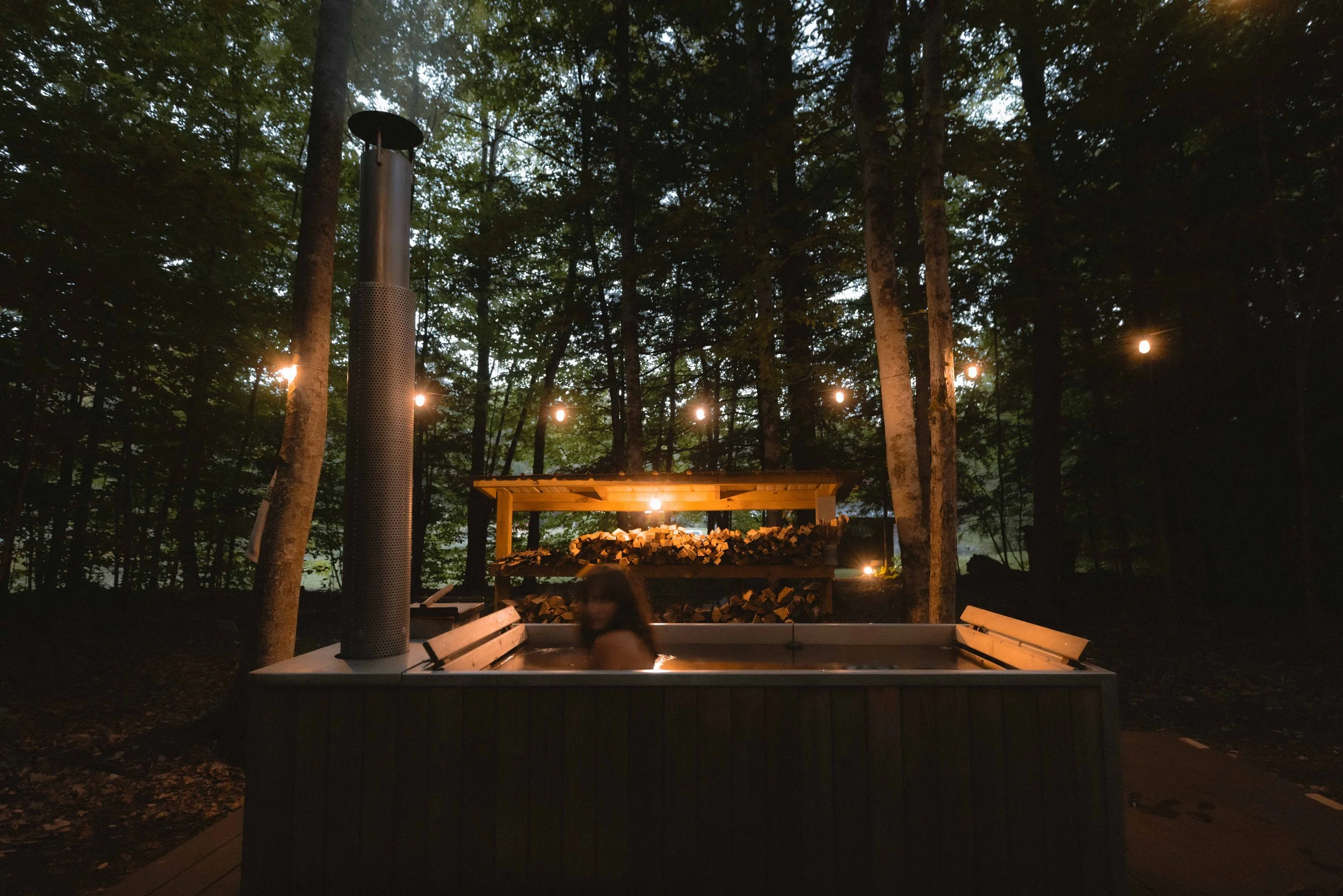
Walk to the end of the road and back. Sit by the river with your feet in the water. Light the fire and watch it for an hour. Soak in the hot tub until the sky gets dark and the stars come out. Cook a slow breakfast with no podcast playing (remember birdsong?).
These are not nothing. They're the whole point. The reason you came.
Our guests at Tanglebloom consistently tell us that the things they remember most aren't the hikes or the farmers' market hauls — it's the hour they spent in the wood-burning hot tub watching the moon rise. The morning they sat on the porch wrapped in a blanket with coffee until the misty fog over the river lifted. The evening they did absolutely nothing and felt completely fine about it.
That's the thing to optimize for.
On Feeling Like You Should Be Doing More
At some point during your stay, you will probably feel restless. Like you should be out exploring, or being productive, or making the most of your time. This feeling is normal. It's also lying to you.
The restlessness isn't boredom — it's withdrawal. Your brain is accustomed to stimulus, novelty, and the small dopamine hits of tasks completed and messages answered. When those disappear, it gets antsy. The antsy feeling is not a sign that you're wasting your time. It's a sign that the reset is working.
Sit with it. Let it pass. Try not to reach for your phone.
On the other side of that restlessness is something that's hard to describe to someone who hasn't experienced it: a kind of quiet alertness. A sense that the world has slowed down to a manageable pace. The feeling of actually being inside your own life instead of managing it from a distance.
It usually takes about 36 hours. If you can? Please, give yourself the 36 hours.
A Note on Doing It Together
If you're coming with a partner, talk about this before you arrive. Not in a serious, overscheduled way (hah)— just a gentle agreement that you're both there to actually rest, not to perform vacationing.
That might mean you spend a morning doing completely different things. Or that you eat breakfast without talking much — or maybe you chat more than you have in weeks! Or that you read in companionable silence instead of filling every moment with conversation (we’re big fans of this one). Some of the best couple trips our guests describe are the ones where they both independently came back to themselves — and then found each other again, quieter and more present.
Rest is not the enemy of connection. It's often the precondition for it.
The Part Where We Tell You to Book the Trip
We know you've been thinking about it. The summer is going to get away from you faster than you expect. June will arrive and weekends will already be gone. October will come and you'll wonder how you let another year pass without that thing you kept saying you wanted to do.
You don't need to have it all figured out. You don't need to know exactly what you'll do when you get here (some guests never leave after check-in and honestly it’s the highest compliment). You just need to put something on the calendar — a stake in the ground that says: this time, I'm doing it.
Tanglebloom Cabin is open May through October. Two nights minimum (we recommend three, if you can swing it). No agenda, no “must do” itinerary — just quiet, a wood-burning hot tub, our working flower farm, and the genuine wild beauty of southern Vermont.
The unplugging part? That we can help with. The rest is just showing up.
Ready to stop almost booking it?
→ Check availability at airbnb.com/h/vermont-cabin-glamping
→ Get early access to new dates & cancellations by joining our email list at the bottom of this page
